Insights
Commissioning Is Not the Last Phase of a Project - It's the Last Opportunity to Prevent Failure
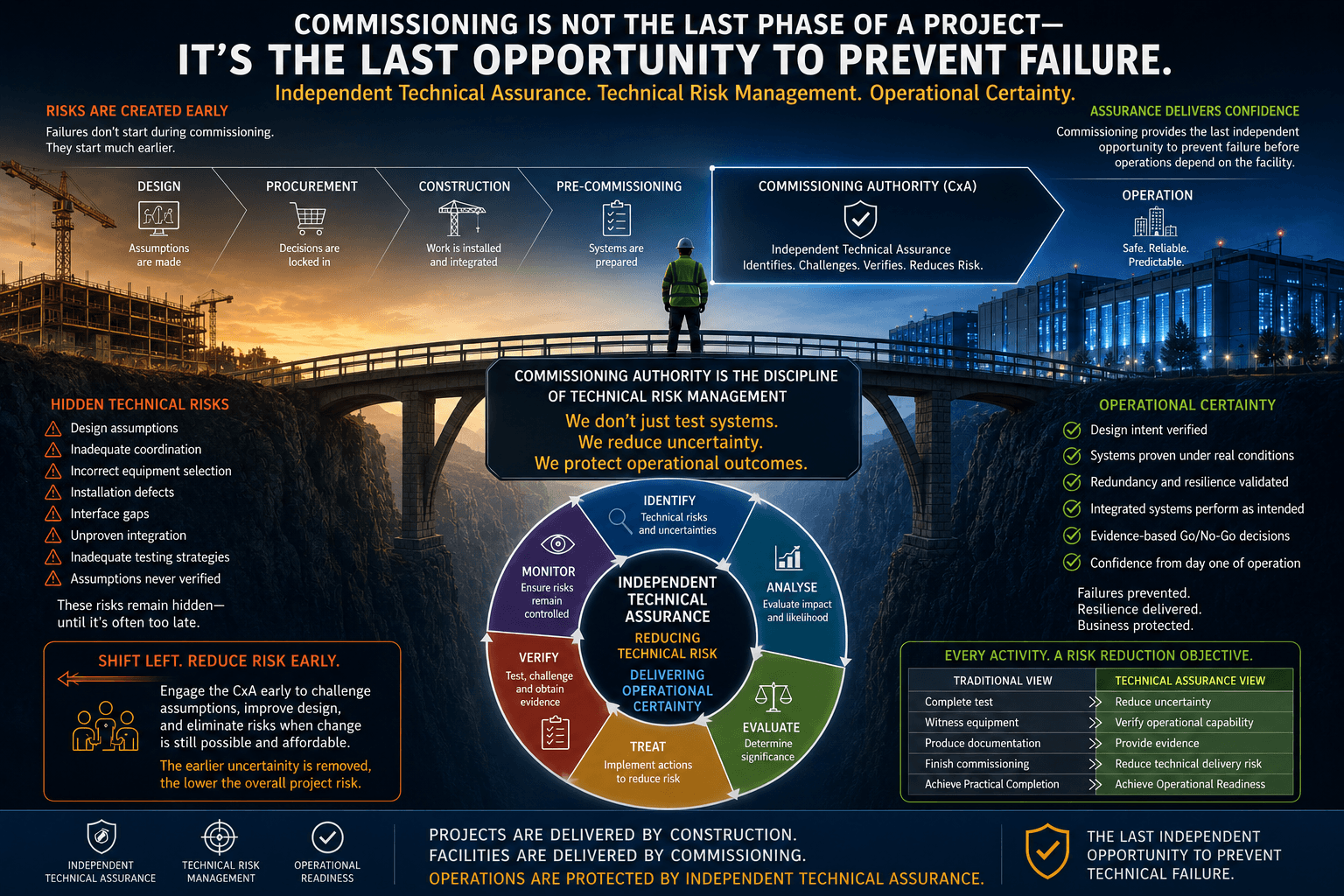
Construction projects often describe commissioning as the final phase of project delivery. While that description is technically correct, strategically, it misses the point.
Commissioning is not simply the final activity before handover. It is the last independent opportunity to identify, challenge, and reduce technical delivery risks before they become operational failures. That distinction changes everything.
Projects Don't Fail During Commissioning
In mission-critical environments, very few failures originate during commissioning. They begin much earlier. They are introduced during design through overlooked assumptions, during procurement through unsuitable equipment selections, during construction through installation defects, or during integration where complex systems fail to operate together as intended.
For months, these risks often remain hidden beneath drawings, schedules, specifications, and progress reports. Commissioning is simply where they are finally exposed. The uncomfortable truth is that commissioning rarely creates technical problems. It reveals them.
This is why the greatest value is unlocked when Independent Technical Assurance is engaged early. By shifting the Commissioning Authority’s (CxA) involvement "left" - into the design and procurement phases - project teams can isolate and eliminate these hidden flaws before they are built into the physical infrastructure.
Commissioning Is More Than Testing
Many organisations still regard commissioning as a programme activity focused on completing tests and achieving Practical Completion. Testing, documentation, and demonstrating compliance are important, but these are outputs - not the purpose.
Every commissioning activity should answer a far more important question: What technical risk does this activity eliminate?
· A functional performance test does more than prove a system operates. It verifies that design intent has been achieved.
· An Integrated Systems Test does more than demonstrate a sequence of operation. It validates the resilience of interconnected infrastructure under realistic operating conditions.
· A witness test is not simply evidence for a checklist. It is proof that a critical uncertainty has been removed.
Viewed through this lens, commissioning transforms from a standard testing process into a structured, strategic process of technical risk reduction.
The Role of Independent Technical Assurance
This is where Independent Technical Assurance (ITA) delivered through an independent Commissioning Authority becomes critical. Unlike organisations responsible for design, construction, or programme delivery, an independent CxA has no commercial interest in declaring success prematurely. Its responsibility is to provide objective technical assurance by asking difficult questions, challenging baseline assumptions, and verifying physical evidence.
Independent Technical Assurance evaluates a project through a rigorous operational lens: Has the design intent been successfully maintained through construction? Are critical systems installed precisely in accordance with approved shop drawings and standards? Have hidden single points of failure been eliminated?
These questions cannot be answered through programme updates or construction progress reports alone. They require independent engineering judgement supported by objective evidence.
Commissioning Authority Is Technical Risk Management
Project teams routinely manage commercial, contractual, programme, and health and safety risks. Yet many of the risks most likely to catastrophically affect operational performance are technical in nature.
Examples of these hidden risks include:
· Protection systems that do not coordinate correctly;
· Control sequences that fail under abnormal or emergency conditions;
· Incomplete or unproven system integration;
· Incorrect equipment configuration and inadequate commissioning strategies;
· Operational procedures that have never been dynamically validated.
These risks often remain entirely invisible until systems are fully energised or placed into live service. The role of an independent Commissioning Authority is to identify, evaluate, and mitigate these technical delivery risks before they affect live operations. This is why a Commissioning Authority should not be viewed merely as a testing discipline. It is a specialist form of technical risk management delivered through independent technical assurance.
Evidence Before Assumption
Every project contains assumptions. The drawings are assumed to be correct. The installation is assumed to match the drawings. Protection studies are assumed to have been implemented correctly, and control philosophies are assumed to operate as intended.
Commissioning replaces assumption with evidence. Every successful test reduces uncertainty. Every technical challenge strengthens confidence. Every defect identified before handover represents a failure prevented rather than a failure experienced.
The ultimate objective is not simply to complete commissioning. In reality, mission-critical data centre projects face severe programme and commercial pressures. The true role of the CxA is to navigate these intense schedule crunches to facilitate confident, evidence-based Go/No-Go decisions. When a multi-million-dollar facility's lifecycle is on the line, core parameters like safety, uptime, and redundancy remain entirely non-negotiable.
Delivering Operational Certainty
Owners are not investing in projects simply to achieve Practical Completion. They are investing in facilities that must operate safely, reliably, and predictably from the very first day of service. That requires more than a successful checklist.
It requires absolute confidence that the technical risks capable of compromising operational performance have been independently identified, challenged, and reduced. This is the true value of Independent Technical Assurance delivered through an independent Commissioning Authority. It transforms commissioning from a contractual close-out activity into a strategic engineering discipline that protects long-term operational outcomes.
Ultimately, commissioning is not the last phase of a project. It is the last independent opportunity to prevent technical failure before a mission-critical facility enters live service.