Insights
If a Commissioning Manager Has Already Been Appointed_Why Does the Owner Appoint an Independent Commissioning Authority (CxA)
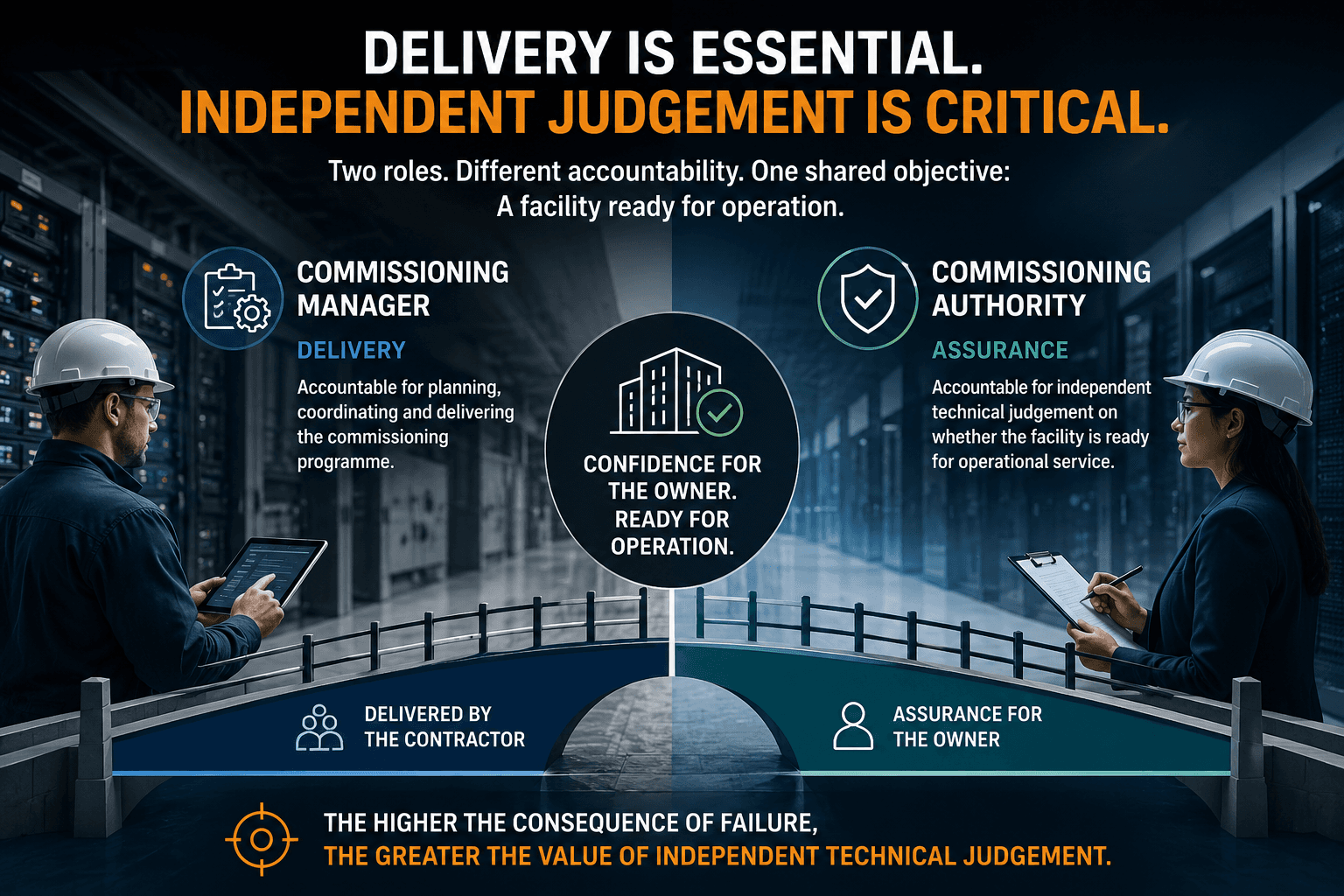
If a competent Commissioning Manager has already been appointed to plan, coordinate and deliver the commissioning programme, what additional value does an independent Commissioning Authority (CxA) bring?
At first glance, the question appears entirely reasonable. Both roles are involved throughout the commissioning process. Both review documentation, attend technical meetings, witness testing, monitor progress and work towards a successful project outcome. To many observers, the distinction can appear unclear, leading some to conclude that appointing both functions creates unnecessary duplication.
However, the conclusion stems from a misunderstanding of the purpose of the two roles.
The issue is not technical competence. Nor is it a question of one role being more important than the other. Rather, it is a question of engineering governance, accountability and representation.
A Commissioning Manager is typically appointed by the General Contractor to plan, coordinate and deliver the commissioning programme in support of the contractor's contractual obligations. Success is measured by the effective execution of commissioning activities, programme performance, completion milestones and contractual handover.
An independent Commissioning Authority serves a fundamentally different purpose. Appointed by the Owner, the Commissioning Authority provides objective technical oversight to help the Owner determine whether the completed facility is genuinely ready to enter operational service. Its primary responsibility is not to deliver the commissioning programme, but to provide independent technical judgement on whether the evidence demonstrates that the Owner's operational, reliability, and business objectives have been achieved.
These responsibilities are complementary rather than competing. The question, therefore, is not whether a Commissioning Manager can deliver a successful commissioning programme. The more important question is whether the organisation responsible for delivering that programme should also be the sole source of assurance that the Owner's investment is operationally ready.
This distinction is not unique to commissioning. The requirement for independent technical judgement does not originate from commissioning. It is a long-established principle of engineering governance applied wherever the consequences of technical failure justify independent challenge.
Across high-consequence engineering disciplines, independent technical review is widely recognised as a cornerstone of good engineering governance. In practice, this means while a Commissioning Manager focuses on keeping testing on schedule, a CxA focuses on whether a subtle test anomaly poses a long-term operational risk.
Independent design reviews, Hazard and Operability (HAZOP) studies, Safety Integrity Level (SIL), systems engineering, functional safety assessments, third-party certification and regulatory approvals all exist for the same fundamental reason: independent technical challenge strengthens engineering decisions, reduces the risk of bias and builds confidence where the consequences of failure are significant.
Mission-critical commissioning should be viewed through the same lens.
The issue is never one of competence or capability – it is one of engineering governance.
An organisation contractually responsible for planning, coordinating and delivering the commissioning programme is accountable for successful project delivery. An independent Commissioning Authority, by contrast, is accountable for providing the Owner with objective technical judgement on whether the evidence demonstrates that the facility is genuinely ready to enter operational service.
These responsibilities are complementary, not competing. One is responsible for delivering the commissioning process; the other is responsible for giving the Owner independent confidence that its outcomes justify accepting operational responsibility. That is why the value of an independent Commissioning Authority should not be measured by the activities it performs, but by the quality of independent engineering judgement it brings to the Owner's most critical decisions.
The debate is therefore not whether a Commissioning Manager can successfully deliver a commissioning programme. They unquestionably can.
The real question is whether the Owner should rely solely on the organisation responsible for delivering the programme to determine whether the completed facility is ready to enter operational service.
In mission-critical engineering, the answer has long been found not in commissioning practice, but in engineering governance.
The higher the consequence of failure, the greater the value of independent technical judgement.
That is why the Commissioning Manager and the Commissioning Authority are not alternative procurement options. They are complementary governance functions, each serving a different client, a different purpose and a different engineering responsibility.