Insights
The Difference Between Quality Assurance and Technical Assurance
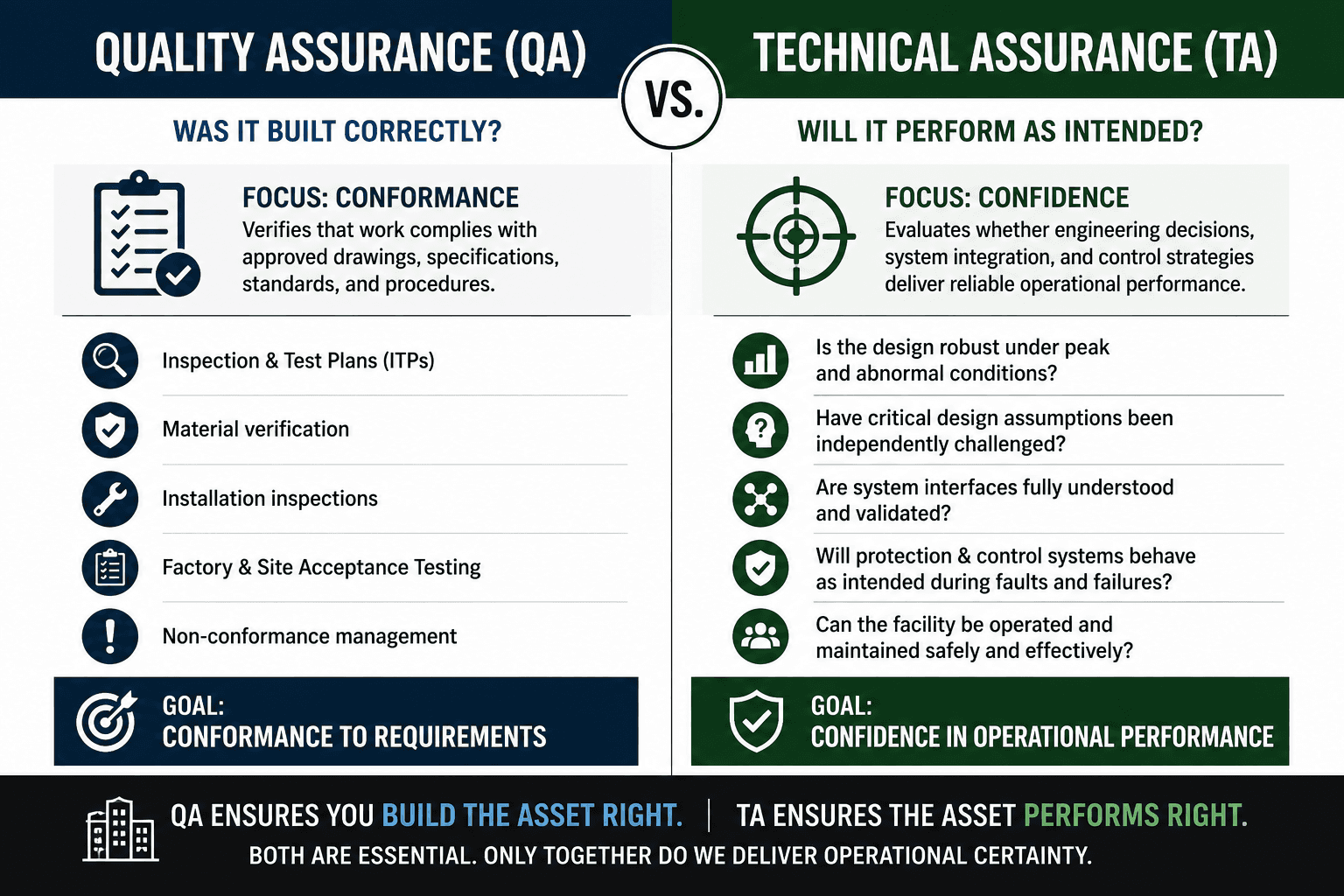
In engineering and construction, the terms Quality Assurance (QA) and Technical Assurance (TA) are often used interchangeably. In my experience, they are related - but they are not the same. Understanding the distinction is important because projects can achieve a high standard of workmanship and still fail to meet their operational objectives.
Quality Assurance: "Was it built correctly?"
Quality Assurance focuses on ensuring that work complies with defined requirements, specifications, standards, and approved procedures.
Typical QA activities include:
Inspection and Test Plans (ITPs)
Material and equipment verification
Installation inspections
Factory and site acceptance testing
Documentation reviews
Non-conformance management
QA provides confidence that the project has been delivered in accordance with the specified quality requirements. It answers the question: "Was the work completed correctly?"
Technical Assurance: "Will it perform as intended?" Technical Assurance takes a broader view. It evaluates whether the engineering decisions, system integration, operational strategies, commissioning approach, and technical risks are aligned with the client's business objectives and the facility's intended performance.
Technical Assurance considers questions such as:
Is the design technically robust?
Have critical assumptions been independently challenged?
Are system interfaces fully understood?
Have operational risks been identified and reduced?
Can the facility be operated safely and reliably?
Will the completed asset achieve its intended operational outcomes?
Technical Assurance therefore addresses a different question: "Will the completed facility perform reliably in operation?"
The Relationship Between QA and Technical Assurance
Quality Assurance verifies compliance. Technical Assurance evaluates confidence.
A project may have excellent QA records, complete inspection reports, and fully signed-off documentation, yet still carry significant technical risks arising from design assumptions, system integration, protection philosophy, control logic, maintainability, or operational readiness.
Conversely, Technical Assurance depends on effective QA. Without reliable installation quality and verified documentation, meaningful technical assurance becomes much more difficult.
The two disciplines complement one another rather than compete.
Why This Matters for Mission-Critical Projects
For data centres and other mission-critical facilities, success is measured by operational performance - not simply by construction completion.
Owners ultimately expect systems to operate safely, reliably, and predictably from the first day of operation.
Achieving that outcome requires more than verifying compliance with specifications. It requires independent technical judgement throughout the project lifecycle to identify uncertainties, challenge assumptions, and reduce technical delivery risk before systems become operational.
That is where Technical Assurance adds value.
Final Thought
Quality Assurance helps ensure that a project is built correctly.
Technical Assurance helps ensure that the right engineering decisions have been made so the completed facility performs as intended.
Both are essential. However, while Quality Assurance focuses on conformance, Technical Assurance focuses on confidence. Projects need both if they are to achieve true operational certainty.